

Imagine this: you’re a skilled professional from outside the EU who has just landed a promising job opportunity in Berlin. The role fits your experience perfectly, the company is eager to hire you, and you’re already picturing your new life in Germany. But just as you begin the visa process, you discover something unexpected, the salary requirement for the visa has increased. Suddenly, your dream opportunity comes with a new challenge. Stay informed about the latest EU Blue Card Updates to navigate these changes smoothly.
For many international professionals, the EU Blue Card is the fastest route to building a career in Germany. It allows highly qualified non-EU workers to live and work in Europe while offering long-term benefits such as family reunification and permanent residency pathways. Germany remains the largest issuer of EU Blue Cards, granting tens of thousands each year as it competes globally for skilled professionals.
However, beginning in 2026, new salary thresholds will apply to EU Blue Card applicants in Germany. The minimum salary requirement is increasing to €50,700 for standard occupations and €45,934 for shortage occupations, representing roughly a 12% increase compared to the previous thresholds. These changes align with economic growth and wage adjustments across the German labor market.
Although the increase may appear challenging at first, it also signals something important: Germany’s demand for skilled international workers remains strong. With labor shortages projected to exceed hundreds of thousands of skilled roles in the coming years, the country continues to rely on global professionals to sustain its economy.
This guide explains the EU Blue Card Updates 2026 salary requirements in Germany, the policy updates behind them, and how expats can adapt their job search and visa strategy to succeed.
EU Blue Card Updates
Section 1: Understanding the EU Blue Card Basics
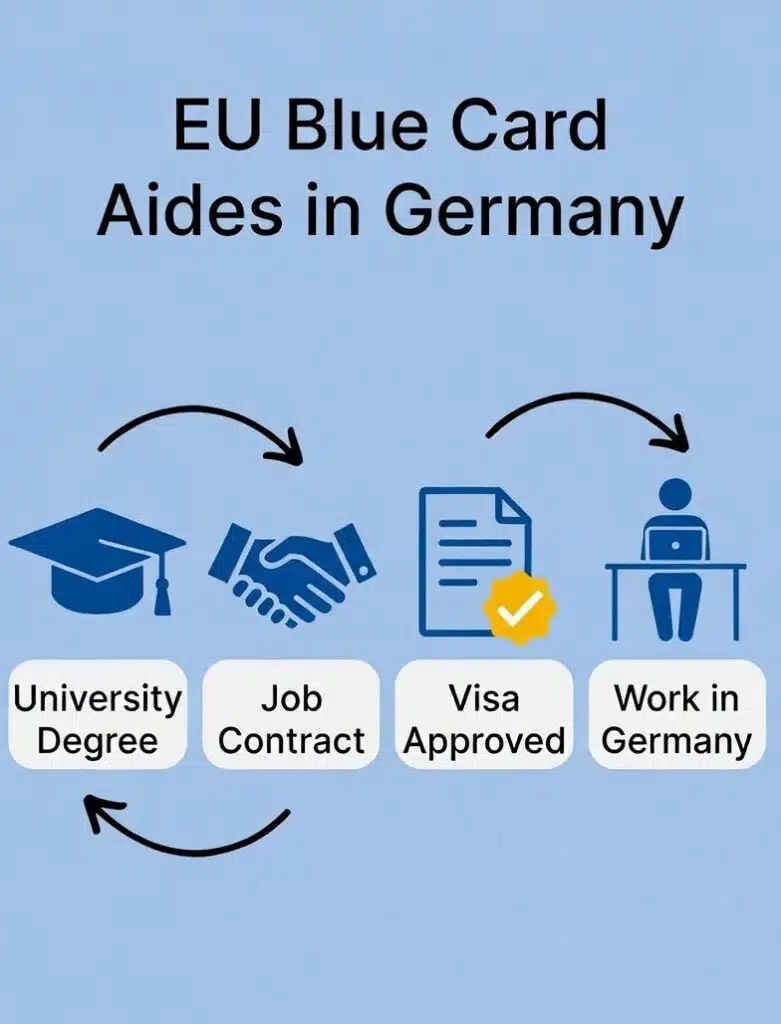
The EU Blue Card is a residence permit designed to attract highly qualified professionals from outside the European Union. Introduced to help European countries compete for global talent, the program allows skilled workers to move to Germany with a streamlined immigration process and long-term career opportunities.
To qualify for a Blue Card in Germany, applicants generally need a recognized university degree or equivalent professional qualification. In some cases, professionals with at least five years of relevant work experience in high-demand industries can also qualify. Another essential requirement is a job offer from a German employer that meets the minimum salary threshold established for the program.
Germany has simplified the process through what is often called a “one-stop-shop” application system. Instead of navigating multiple bureaucratic procedures, applicants typically submit their employment contract, proof of qualifications, and supporting documents through the German embassy or immigration authority. Once approved, the Blue Card grants both residency and work authorization, making the transition to Germany significantly easier for skilled professionals.
Germany’s popularity among Blue Card applicants is no accident. The country offers a strong economy, world-class industries, and an environment that actively encourages skilled migration. Sectors such as information technology, engineering, and healthcare consistently face labor shortages, creating opportunities for international professionals to build long-term careers.
Beyond employment opportunities, the Blue Card offers several practical advantages. Holders can bring their immediate family members to Germany, and spouses are typically allowed to work without restrictions. Additionally, the program offers a clear pathway to permanent residency. In most cases, Blue Card holders can apply for permanent residence after 33 months, or even 21 months if they achieve B1-level German language proficiency.
These benefits make the Blue Card one of the most attractive immigration pathways for skilled workers globally. But as Germany’s economy evolves, so do the policies that govern this program.
And that brings us to the biggest change coming in 2026: updated salary thresholds.
Section 2: Breaking Down the 2026 Salary Threshold Changes
Starting in 2026, Germany will implement updated salary requirements for the EU Blue Card program. These thresholds determine whether a job offer qualifies for Blue Card eligibility and are adjusted periodically to reflect changes in the German economy.
Below is a comparison of the 2025 and 2026 salary thresholds.
| Category | 2025 Threshold | 2026 Threshold | Increase |
|---|---|---|---|
| Standard Occupations | €45,300 | €50,700 | ~12% |
| Shortage Occupations | €41,041 | €45,934 | ~12% |
The increase reflects Germany’s effort to keep immigration standards aligned with wage growth and economic performance. By adjusting the minimum salary requirement, the government ensures that international professionals receive competitive pay while maintaining fairness across the labor market.
Shortage occupations receive a reduced salary threshold because these sectors face particularly severe workforce shortages. The reduced requirement, approximately 10 percent lower than the standard threshold, allows companies to recruit global talent more easily in fields where local labor supply is insufficient.
Shortage occupations typically include professions in science, technology, engineering, mathematics, and healthcare. Examples frequently listed by Germany’s Federal Employment Agency include software developers, IT specialists, engineers, medical professionals, and nursing staff. These fields are essential to Germany’s economic competitiveness and technological innovation.
Importantly, the list of shortage occupations is reviewed regularly, meaning new professions can be added as labor market conditions change. This ensures the Blue Card program continues to support industries facing genuine workforce gaps.
The salary adjustment itself is tied to broader economic indicators, including wage trends and GDP growth. Rather than being an arbitrary policy shift, the increase reflects Germany’s ongoing effort to maintain a balanced immigration system, one that attracts skilled professionals while protecting labor standards.
For expats considering Germany, the takeaway is clear: higher salary thresholds raise the bar, but they also reinforce the value of high-skill expertise in the German job market.
Section 3: Key Statistics: The Bigger Picture of EU Blue Card Trends
Europe just opened the gates for 2026
— Ruffin Perri-Greno (@gyina_yie) January 5, 2026
Legit companies + platforms actively hiring internationals (many sponsor visas/relocation).
1. Tech & Engineering (visa sponsorship confirmed)
• @Spotify – Stockholm, Berlin, London
• @bookingcom – Amsterdam (huge relocation package)
•… pic.twitter.com/sH9V5keC2S
Recent statistics show that the EU Blue Card program continues to expand in Germany despite policy adjustments. In 2024, more than 25,000 Blue Cards were issued, representing roughly a 15 percent increase compared to the previous year. This upward trend highlights Germany’s growing reliance on international professionals.
Industry data also reveals that the majority of Blue Cards are concentrated in a few key sectors. Approximately 60 percent of Blue Card recipients work in IT and engineering roles, with the technology sector alone accounting for nearly 40 percent of all permits issued. These numbers reflect Germany’s rapidly expanding digital economy and the urgent need for skilled developers, engineers, and technical specialists.
At the same time, Germany continues to face a massive labor shortage. Current estimates suggest that the country has more than 300,000 unfilled skilled positions, particularly in technical and healthcare professions. International workers have become an essential solution to this challenge, filling around 20 percent of high-skill workforce gaps.
However, as salary thresholds rise, approval rates for some applications have slightly declined. Analysts estimate that approval rates may drop by about 5 percent in the short term, primarily due to applicants whose job offers fall below the new minimum salary requirements.
Despite these hurdles, demand for the EU Blue Card remains strong. Immigration experts expect applications from Asia and other global talent hubs to increase by 10–15 percent by 2026 as professionals continue seeking opportunities in Europe’s largest economy.
The long-term outlook remains optimistic. Germany has publicly stated its goal of attracting up to one million skilled migrants by 2030, making programs like the EU Blue Card central to its economic strategy.
Section 4: How These Updates Affect You as an Expat
For expats planning to work in Germany, the updated salary thresholds introduce both challenges and opportunities. The key is understanding how these changes affect the visa process, job negotiations, and long-term compliance.
One of the most immediate challenges appears during the visa application stage. Because the Blue Card requires proof that your job offer meets the minimum salary threshold, applicants must ensure that their employment contract clearly reflects the required income level. If the salary falls even slightly below the threshold, the application may be rejected or delayed.
Negotiating salary therefore becomes a crucial part of the process. Employers in Germany are often aware of the Blue Card thresholds, but candidates should still verify that their contract meets the requirement before accepting an offer. This is especially important for professionals transitioning from smaller companies or startups where salary structures may vary.
Another key factor is targeting roles that naturally meet the threshold. Job seekers can increase their chances by focusing on industries where salaries already exceed the Blue Card minimum, such as technology, engineering, and specialized healthcare positions.
Online platforms play an important role in this search. Professional networks like LinkedIn and German job portals such as StepStone frequently list positions that explicitly mention Blue Card eligibility. These postings indicate that employers are prepared to sponsor international professionals and meet the necessary salary requirements.
Consider the example of Alex, a software developer from outside the EU who successfully secured a job in Germany. By emphasizing his expertise in a shortage occupation and highlighting his experience in high-demand technologies, Alex negotiated a €52,000 salary offer, comfortably above the 2026 threshold for standard occupations. His case illustrates how specialized skills and strategic job targeting can make a significant difference.
Compliance after arrival is equally important. Blue Card holders must continue meeting program requirements throughout their stay. If you change employers or switch industries, immigration authorities may review your new employment contract to ensure it still meets salary and qualification criteria.
Family considerations also play a role. Because spouses and dependents receive residency benefits through the Blue Card, maintaining compliance with the program becomes essential for the entire household.
While the process can feel intimidating at first, preparation makes a huge difference. Understanding the requirements early allows expats to approach job negotiations confidently and avoid unnecessary complications during the visa application process.
Section 5: Actionable Tips to Thrive Under the New Thresholds
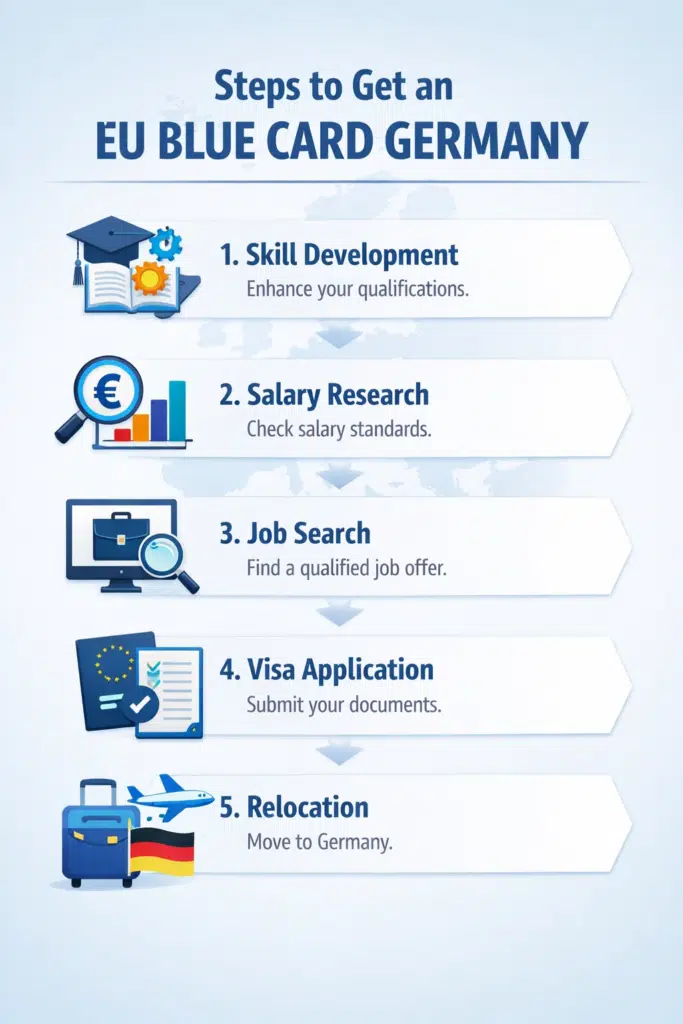
Adapting to the new EU Blue Card salary requirements requires a proactive strategy. Professionals who prepare early often find it easier to meet the thresholds and secure competitive job offers in Germany.
The first step is investing in skills that align with shortage occupations. Fields such as artificial intelligence, cybersecurity, cloud computing, engineering design, and healthcare technology remain in extremely high demand. Professionals who specialize in these areas often command salaries that naturally exceed the Blue Card threshold.
Another useful approach is researching salary benchmarks before negotiating a job offer. Online salary calculators and labor market reports can help applicants understand typical compensation ranges for their profession in Germany. This information provides valuable leverage during negotiations and helps ensure that job offers meet immigration requirements.
Consulting migration experts can also be beneficial. Immigration advisors and relocation consultants often provide guidance on visa procedures, documentation, and employment contracts. Their expertise can prevent costly mistakes during the application process.
Community support is another valuable resource. Online expat forums, professional networks, and migration webinars frequently share practical advice about job searches, salary negotiations, and relocation challenges. Engaging with these communities helps newcomers learn from the experiences of others who have already navigated the process.
Finally, using official government resources ensures that applicants stay updated on the latest immigration policies. Germany regularly publishes guidance for international professionals through official portals designed to simplify the relocation process.
By combining skill development, salary research, professional advice, and community insights, expats can position themselves strongly for success under the new salary thresholds.
Conclusion: Your Path to a Blue Card Success Story in 2026
The EU Blue Card 2026 salary requirements in Germany represent a shift in immigration policy, but they do not close the door for skilled professionals. Instead, they reflect Germany’s effort to maintain competitive wages while continuing to attract global talent.
With minimum salaries increasing to €50,700 for standard roles and €45,934 for shortage occupations, applicants must approach job searches and negotiations more strategically. At the same time, strong demand for professionals in technology, engineering, and healthcare means opportunities remain abundant.
Germany’s long-term goal of welcoming large numbers of skilled migrants demonstrates that international professionals will continue to play a vital role in the country’s economic future.
For aspiring expats, the message is clear: the bar may be higher, but the opportunity is still wide open.
If you’re planning to work in Germany, bookmark this guide for your visa preparation, share your experiences with other professionals, and stay informed about upcoming immigration updates.
Because in 2026, your expertise could become part of Europe’s innovation engine—so start negotiating your opportunity today.

 English
  German