
Umzug nach Deutschland from the UK used to be relatively simple. British citizens could live and work anywhere in the EU without visas thanks to freedom of movement. That changed after Brexit, which ended automatic residency rights for UK nationals.
Moving to Germany from the UK
Today, moving to Germany is still possible, but the process now requires planning, paperwork, and the correct visa. UK citizens can visit Germany visa-free for up to 90 days within 180 days, Aber staying longer requires a residence permit connected to work, study, or family reunification.
Despite these new rules, Germany remains one of the most attractive relocation destinations in Europe. The country has Europe’s largest economy, strong demand for skilled professionals, and a reputation for stability. Workers also benefit from strong labour protections, generous holidays, and shorter working hours, which often lead to a better work-life balance compared with the UK.
Another factor attracting British expats is cost of living. While cities like Munich are expensive, many German regions remain cheaper than London or the South East of England, especially when it comes to rent and transport.
New travel systems are also arriving in 2026. The EU will introduce the Entry/Exit System (EES) to digitally record border crossings. Later in 2026, UK travellers will also need an online travel authorisation under ETIAS before entering the Schengen area.
Zusamenfassend: Umzug nach Deutschland is still very achievable for UK citizens — but preparation is essential. This guide explains the legal rules, visa options, living costs, work opportunities, and the key steps needed to settle in successfully.
Post-Brexit Legal Basics: Can You Move to Germany?
Since Brexit, British citizens are legally classified as third-country nationals under German immigration law. This means they must follow immigration rules similar to citizens from countries such as Canada or Australia.
Short visits remain straightforward. UK passport holders can stay in the Schengen area for up to 90 days within a 180-day period without a visa. During this time, many people travel to Germany to attend interviews, explore housing options, or prepare relocation plans.
Jedoch, anyone planning to live in Germany longer than three months must obtain a residence permit.
Many UK citizens choose to enter Germany visa-free and apply for a residence permit after arrival. The application must normally be submitted within the first 90 days, and it is processed by the local immigration authority known as the Ausländerbehörde.
People who were already living in Germany before 2021 have a different legal status. Their rights are protected under the EU–UK Withdrawal Agreement. These residents must hold a special residence document confirming their protected status but can continue living and Arbeiten in Deutschland.
For official guidance, UK citizens should always check reliable government resources such as GOV.UK and visa guidance from the German Federal Foreign Office.
Understanding these legal basics is the first step before planning any relocation.
Visa and Residence Permit Options for UK Citizens
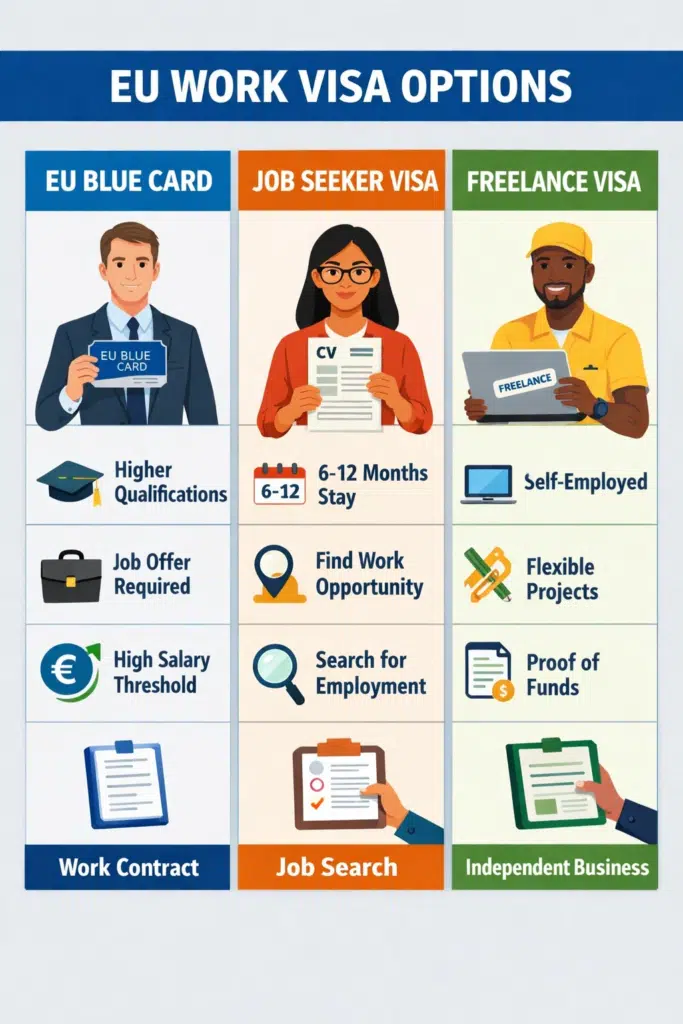
British citizens who want to live and work in Germany must apply for a residence permit that matches their reason for moving. The most common route for professionals is the Blaue Karte EU, designed for highly skilled workers with recognised degrees and qualifying salaries.
Die EU Blaue Karte allows professionals to work in Germany while offering a faster path to permanent residency compared with many other visa routes. Engineers, IT specialists, and scientists frequently qualify for this permit.
Another option is the skilled worker Aufenthaltserlaubnis, which allows qualified professionals to work in Germany even if their salary does not meet the Blue Card threshold. Germany has expanded this pathway in recent years because of labour shortages.
Some people move before securing employment. In these cases, Germany offers a Visum für Arbeitssuchende, allowing professionals to stay in the country for up to six months while searching for work.
Freelancers and entrepreneurs also have specific visa routes. Self-employed professionals such as designers, consultants, and artists can apply for a freelance residence permit, while entrepreneurs launching businesses may apply under Section 21 of the German Residence Act.
One critical requirement applies to all residence permits: valid Krankenversicherung is mandatory. Without proof of insurance, applications are often refused by immigration authorities.
Main Residence Permit Options
| Permit | Who It’s For | Typical Duration | Permanent Residency Path |
|---|---|---|---|
| Blaue Karte EU | Degree + job offer | Up to 4 years | 21–33 months |
| Skilled Worker Visa | Recognised qualifications | Contract duration | ~5 years |
| Visum für Arbeitssuchende | Degree + proof of funds | 6 Monate | Convert after job |
| Freelance Visa | Self-employed professionals | 1–3 years | ~5 years |
Choosing the correct visa is one of the most important decisions when planning your move.
Planning & Costs: Budgeting Your Move
Relocating to Germany involves several upfront costs, especially during the first months after arrival. Most newcomers spend between €5,000 and €10,000 during the initial setup phase.
Shipping household belongings from the UK typically costs €2,300–€3,200, depending on the amount of furniture and the moving service used. Housing deposits are another major expense because German landlords usually require two to three months’ rent as security.
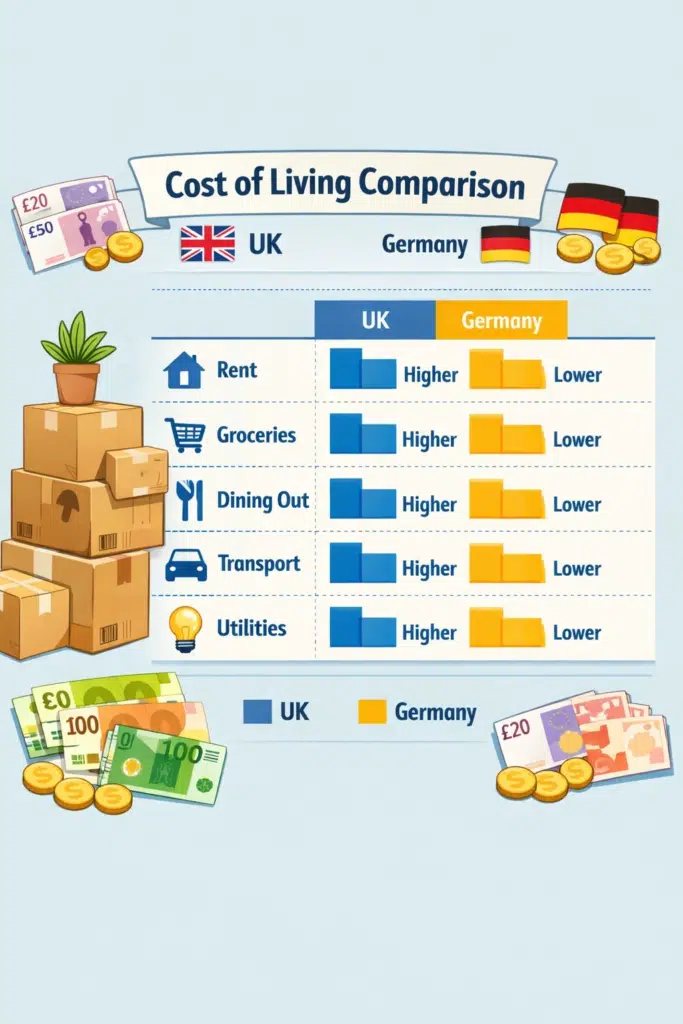
Despite these costs, everyday life in Germany can be cheaper than in the UK. Rent, groceries, and transport are often lower, particularly outside major cities.
Cost of Living Comparison
| Expense | Deutschland | Vereinigtes Königreich |
|---|---|---|
| 1-bed city centre rent | £744 | £1,031 |
| Transport pass | £42 | £70 |
| Restaurant meal | £14 | £20 |
Many expats recommend using multi-currency Bankkonten when transferring money between pounds and euros to avoid high foreign exchange fees.
Planning your finances before moving can prevent many common relocation problems.
Finding Work in Germany
Germany has one of Europe’s strongest labour markets and continues to recruit international professionals. Skilled workers are particularly needed in sectors such as engineering, software development, Gesundheitspflege, and finance.
Arbeitssuchende commonly use platforms like Make it in Germany, StepStone, and LinkedIn.
International companies in cities such as Berlin, Munich, and Frankfurt often hire English-speaking professionals. However, learning German significantly improves long-term career opportunities.
Employees in Germany also benefit from strong labour protections. Full-time workers typically receive 20 to 30 days of paid annual leave, plus Feiertage.
Gehäuse, Best Cities & Daily Life Setup
Finding accommodation can be challenging, especially in major cities where demand is high. Rental listings commonly appear on Immobilienscout24.
Tenants usually need to provide proof of income, identification documents, and a credit report known as a Schufa record.
Once a property is secured, the landlord provides a document called a Wohnungsgeberbestätigung. This confirmation is required for official address registration.
Popular Cities for UK Expats
| Stadt | Key Advantages | Rent Level |
|---|---|---|
| Berlin | International community, creative industries | Mäßig |
| München | High salaries, strong economy | Expensive |
| Frankfurt | Financial centre | Hoch |
| Hamburg | Coastal city with strong economy | Mäßig |
| Leipzig | Affordable housing, growing tech scene | Lower |
Driving in Germany is relatively simple for British citizens. A UK driving licence is typically valid for six months after registering residency, after which it can usually be exchanged for a German licence.
Many expats also open a German bank account known as a Girokonto through banks such as N26 or Commerzbank.
Healthcare, Insurance & Family Matters
Germany operates a mandatory health insurance system. Unlike the UK’s National Health Service, healthcare in Germany is funded through insurance contributions rather than general taxation.
Most employees join the statutory public insurance system, where contributions equal roughly 14–15% of salary, shared between employer and employee.
Healthcare quality is widely regarded as excellent, with modern hospitals and relatively short waiting times.
Families relocating to Deutschland benefit from free public education and financial support programs such as Kindergeld, a monthly allowance for children.
Pets can also move to Germany, provided they have microchips, rabies vaccinations, and official health certificates.
Taxes, Pensions & Financial Planning
Once you register your address through Anmeldung, you usually become a Deutsche Steuer resident. This means the country may tax worldwide income, including employment earnings and investment income.
The UK–Germany Double Taxation Agreement prevents the same income from being taxed twice.
However, some UK investment products such as ISAs may lose their tax-free status. Germany typically applies capital gains tax of around 26.375% on investment profits.
Before relocating, many expats notify HM Revenue and Customs and obtain a German tax identification number once registered locally.
Arrival Checklist: First 30 Days
The first month in Germany usually involves several administrative steps. Most newcomers start by securing temporary accommodation and arranging their residence permit appointment.
One essential task is registering your address at the local citizens’ office (Bürgeramt). This process, known as Anmeldung, normally must be completed within 14 days of moving into a property.
After registration, the government sends your German tax ID by post. This number is required for employment, banking, and tax purposes.
Other tasks include opening a bank account, activating health insurance, and obtaining a local mobile phone contract.
Culture, Integration & Is It Worth It?
Life in Germany often feels different from the UK. Many British expats describe daily life as calmer and more structured. Public transport systems are reliable, cities are generally safe, and work-life balance is strong.
Traditional social spaces such as beer gardens and festivals remain important parts of German culture. Events like Oktoberfest highlight these traditions.
However, adapting to bureaucracy can take time. Administrative processes may involve paperwork and appointments, and learning German becomes important for long-term integration.
Who Germany Suits Best
| Ideal For | Less Suitable For |
|---|---|
| Skilled professionals | People seeking ultra-low taxes |
| Families with children | Those who dislike bureaucracy |
| Engineers and IT workers | People unwilling to learn German |
| Professionals seeking work-life balance | Those wanting fast administration |
For many British expats, the adjustment period lasts several months — but the long-term lifestyle benefits often outweigh the challenges.
Abschluss
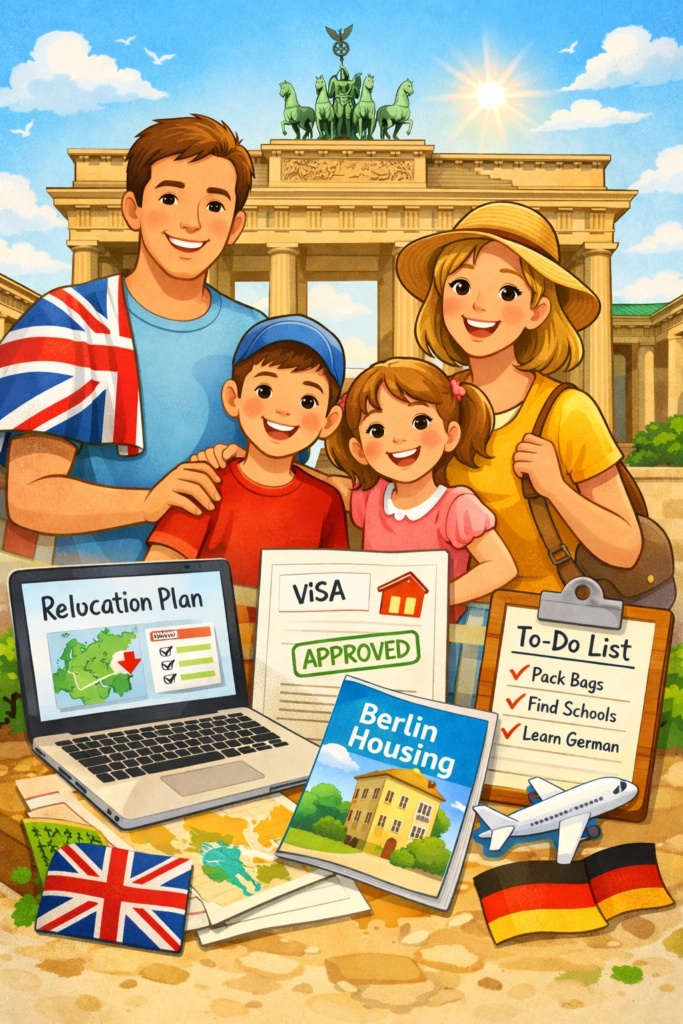
Moving to Germany from the UK is no longer automatic, but it remains a realistic and achievable goal. Understanding visa requirements, budgeting for relocation costs, and completing administrative tasks such as address registration and Krankenversicherung are the most important steps.
For many professionals and families, Germany offers strong career opportunities, reliable infrastructure, and a high quality of life.
Prospective movers should begin their research using official resources such as GOV.UK, the relocation portal Make it in Germany, and visa guidance from the German Federal Foreign Office.
The most practical first step is simple: check which German visa you qualify for and begin planning your relocation timeline.

 German
  English